Commoditized Knowledge and the Premium Content Pivot
The era of answering questions is over. As Google's Knowledge Vault reaches high confidence in factual queries, publishers must prioritize Information Gain and proprietary data to survive.
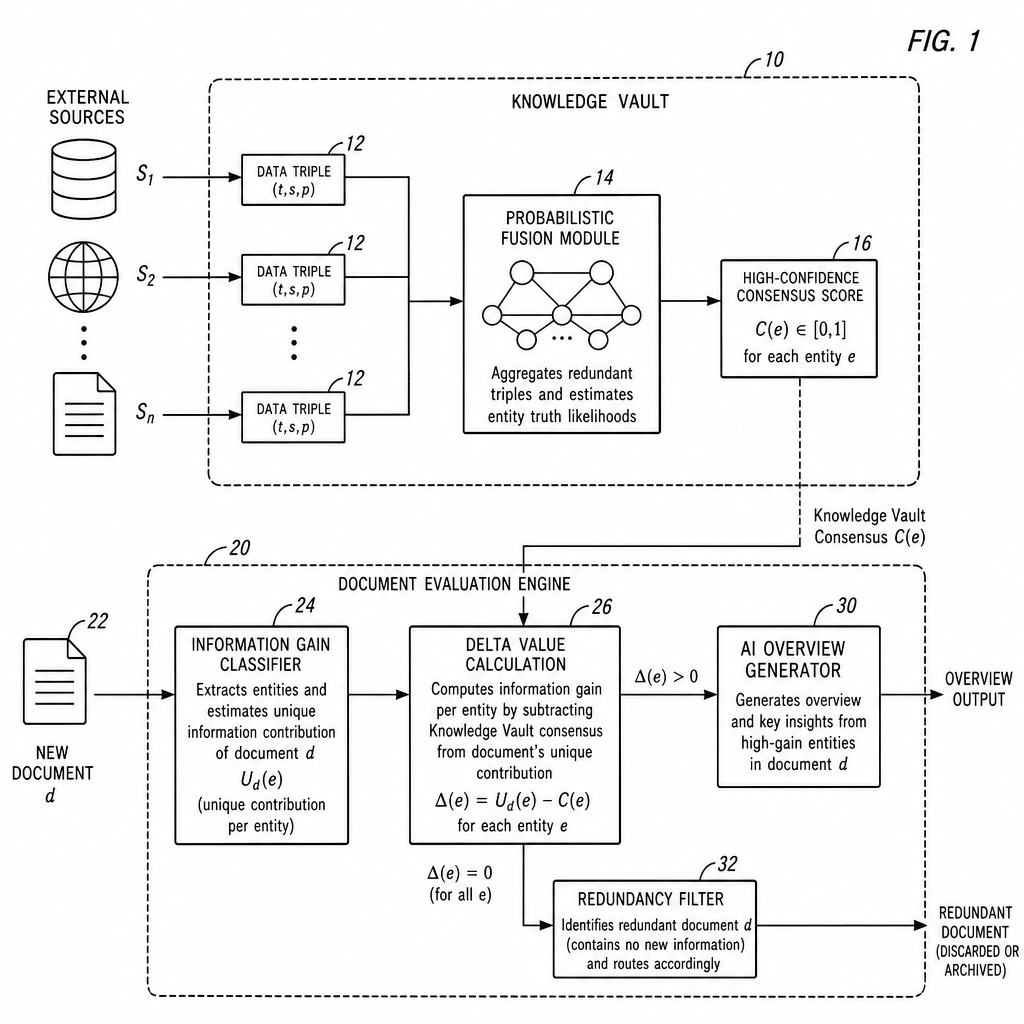
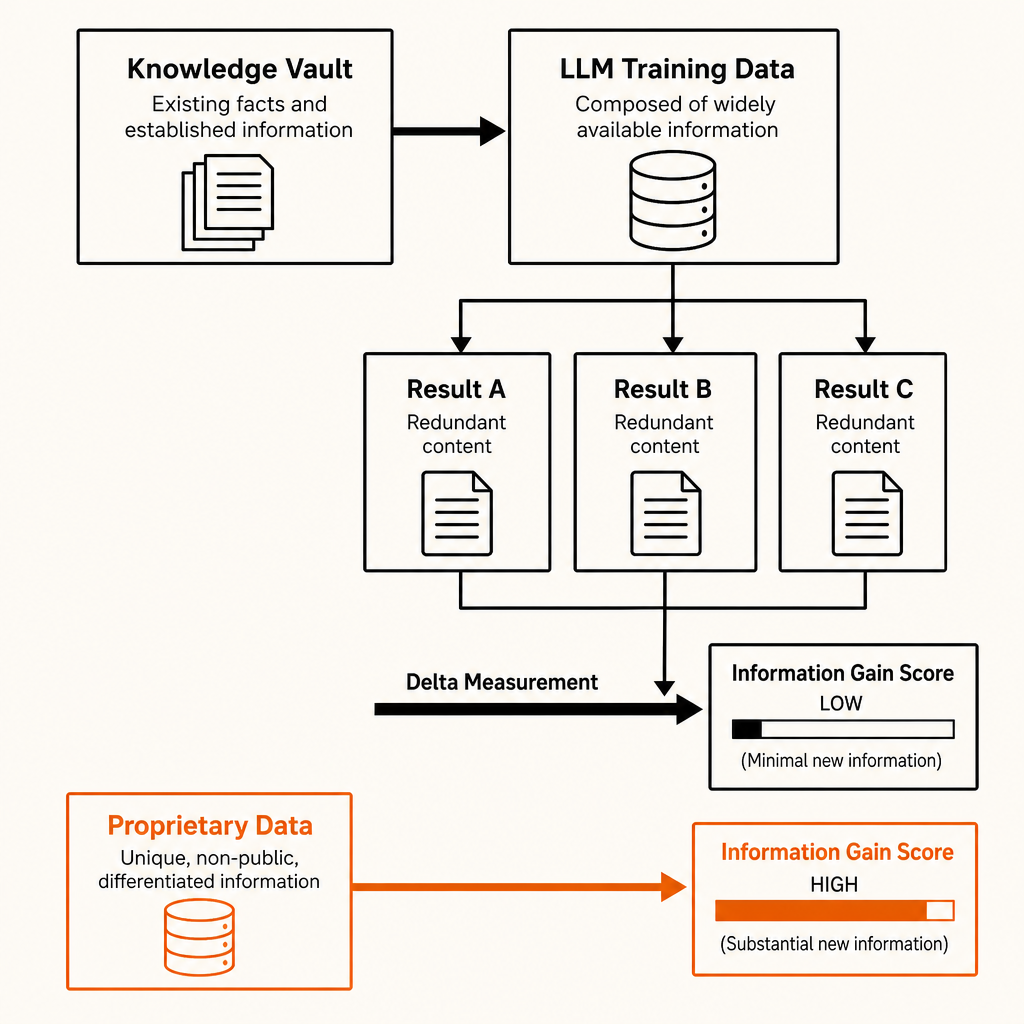
The era of "answering questions" as a viable SEO strategy is dead. If your content can be synthesized by a Large Language Model (LLM) using existing training data, your organic traffic is a depreciating asset. Google’s transition from a search engine to an answer engine—codified in the Knowledge Vault (US10678819B2)—means the system already possesses the probabilistic confidence to resolve factual queries without ever sending a user to your website.
To survive the maturation of AI Overviews, practitioners must pivot from "Commoditized Knowledge" to "Information Gain." This is not an aesthetic preference; it is a mathematical necessity. Google's ranking systems now utilize site-wide classifiers to demote domains that fail to provide a unique delta—defined as information that does not already exist within the Knowledge Graph. If you are not providing proprietary data, first-person experimentation, or "Entity-led" insights, you are merely noise in a system designed to filter for signal.
The Knowledge Vault and the Death of Fact-Based Content
Google’s Knowledge Vault represents a fundamental shift from the traditional Knowledge Graph. While the Graph relied on curated sources like Freebase or Wikipedia, the Vault uses probabilistic fusion to extract (subject, predicate, object) triples directly from web text, tables, and DOM trees. It assigns a confidence score to every fact it finds. If 10,000 sites all say "SEO stands for Search Engine Optimization," the Vault’s confidence reaches 99.9%.
Once the Vault reaches high confidence on a fact, any blog post merely repeating that fact is rendered redundant. Under the Information Gain paradigm, Google’s ranking algorithms are incentivized to bypass "redundant" documents. If your page does not offer a new "triple" or a unique perspective that the Vault cannot yet confidently verify, you will be relegated to the bottom of the SERP or excluded from the Retrieval-Augmented Generation (RAG) context window that powers AI Overviews.
Information Gain: The Only Remaining Ranking Factor That Matters
Information Gain is the measure of how much new information a document provides relative to what the user (or the LLM) already knows. As outlined in Patent US20220277028A1, Google calculates a score based on the delta of new information added beyond session priors. If a user clicks three results and finds the same information in all three, the system views those results as a failure of diversity.
To increase Information Gain, you must move away from "What is [X]" content. Instead, focus on proprietary data sets. For example, rather than writing "How to improve CTR," a high-gain strategy involves publishing "We analyzed 1.2 million headlines in 2024; here is the raw data on click-through variance." This is data the LLM cannot "hallucinate" or find in its training cutoff; it is a unique entity contribution that forces the RAG architecture to cite you as the primary source.
The Consensus Trap: Verification vs. Novelty
SEO practitioners are currently caught in the "Consensus Trap." To rank, you traditionally needed to align with the "consensus" of the top 10 results. However, in an AI-first environment, agreeing with the consensus makes you redundant. Conversely, disagreeing without evidence makes you "unverified."
The solution lies in grounding. Google’s generative models for search summaries (Patent US11620330B2) favor content that provides clear, verifiable evidence for the generative model. You must provide the "proof" for a claim that isn't yet common knowledge. This is the sweet spot: information that is true (verifiable) but not yet part of the Knowledge Vault’s high-confidence set (novel).
RAG Architectures and the Battle for the Context Window
Modern search is increasingly governed by Retrieval-Augmented Generation. When a query is processed, the system retrieves a set of "top-k" documents and feeds them into an LLM's context window to generate a summary. The goal of SEO is no longer just "ranking #1"—it is becoming the grounding source for the LLM.
The selection mechanism for these sources relies heavily on Reciprocal Rank Fusion (US20220207073A1). This describes how Google combines traditional keyword matching (BM25) with dense vector embeddings and Knowledge Graph proximity. To be selected, your content must be "verifiable" yet "novel." If your content is too similar to the LLM's internal weights, the LLM will simply answer from memory. To prevent hallucination, the system pulls in "verifiable evidence" blocks—such as a specific case study or a non-obvious correlation.
The Helpful Content Classifier as a Sitewide Multiplier
The "Helpful Content" system is no longer a niche update; it is a permanent, sitewide classifier. It acts as a multiplier or suppressor based on the aggregate utility of your domain. If 80% of your site consists of commoditized knowledge (e.g., "What is..." definitions), the classifier applies a negative weight to the entire domain, including your high-value pages.
"A site-wide signal... if there's a lot of unhelpful content on a site, it can make the helpful content on that site perform less well." — Google Search Central.
Pruning is now a survival tactic. You must delete or "noindex" content that offers zero Information Gain. Every page on your site must justify its existence by contributing something the Knowledge Vault doesn't already know with 99% certainty.
Winning the "Entity-Led" Search Era
Google is moving from "Strings" to "Things." Keywords are just proxies for entities. To win, you must establish your brand or authors as authoritative entities within a specific knowledge graph. This is achieved through:
- ClaimReview Schema: Explicitly flagging your unique findings so they are easily parsed by the Vault.
- Dense Vector Optimization: Using semantically related terms that demonstrate deep topical coverage beyond the surface-level "consensus" keywords.
- First-Person Attribution: Using "I" and "We" to anchor data in real-world experience, which is a signal the Helpful Content System uses to distinguish human expertise from LLM-generated rehash.
FAQs
What is the mathematical definition of Information Gain in SEO?
In the context of Google's patents, Information Gain is the reduction in uncertainty (entropy) provided by a document relative to the information already present in the searcher's session or the system's internal knowledge base. If your document adds zero new "triples" to the Knowledge Vault, its Information Gain score is effectively zero.
How do AI Overviews (SGE) select their sources?
AI Overviews use a "Query Fan-out" mechanism (US20210406303A1). The system generates synthetic sub-queries, retrieves parallel sets of documents, and uses an LLM to synthesize an answer. Sources are selected based on their ability to "ground" the LLM's claims with verifiable, non-redundant data.
Does Schema.org still help with AI rankings?
Yes, but not for "ranking" in the traditional sense. Schema helps the Knowledge Vault's probabilistic fusion process. By providing structured data, you reduce the "computational cost" for Google to verify your facts, increasing the likelihood that your data is used as the foundational truth for a generative answer.
Should I delete my "What is" blog posts?
If those posts are not driving significant traffic or conversions and merely repeat Wikipedia-level facts, they are likely dragging down your site-wide "Helpful Content" score. Update them with proprietary data or case studies to provide Information Gain, or prune them to protect your domain's neural score.
What to do this week
Audit your top 20 traffic-driving pages. For each page, ask: "Could an LLM write this entire article using only its training data?" If the answer is yes, that page is a liability. Immediately inject proprietary data, unique imagery, or first-person experimental results. Move your technical SEO focus away from "crawling and indexing" and toward "entity verification and information delta." The future belongs to those who own the data, not those who summarize it.